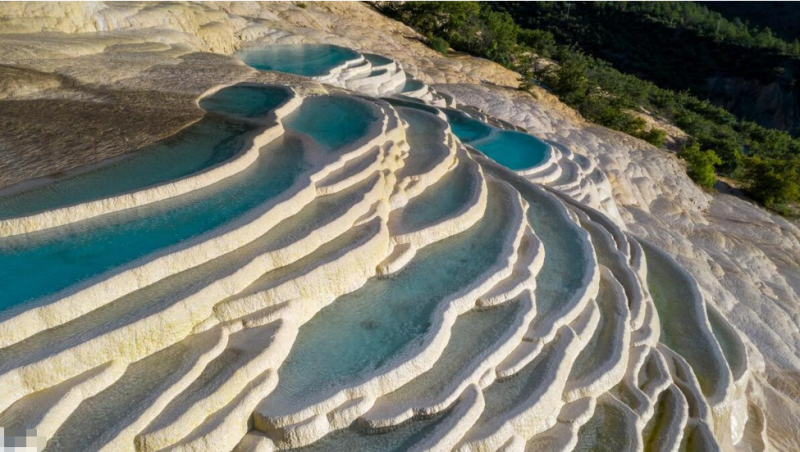
Located at the northern foot of Haba Snow Mountain in Baidi Village, Sanba Township, Shangri-La City, Diqing Tibetan Autonomous Prefecture, Yunnan Province, Baishuitai is the largest cold-spring travertine terrace discovered in China so far. It lies 101 kilometers from the county seat and covers an area of approximately 3 square kilometers.
Situated at an altitude of 2,380 meters, Baishuitai is the birthplace of the Naxi people's Dongba religion. The region features a temperate and plateau climate, with limestone as the dominant rock formation. Its water system is primarily fed by the meltwater from the Jade Dragon Snow Mountain. The unique landscape is formed when dissolved calcium carbonate in the spring water precipitates upon exposure. Sunlight triggers a decomposition reaction, creating white calcium carbonate deposits that continuously cover the ground, resulting in a spectacular karst landform.
Thanks to the "Three Parallel Rivers" geography and significant vertical climate zones, Diqing Prefecture is one of the most biodiverse regions in the world. It is home to over 300 species of mammals, 686 species of birds, and 2,267 species of seed plants, showcasing rich biodiversity with distinct temperate characteristics.
Over centuries of carbonate precipitation, Baishuitai has formed terrace-like curtains that resemble layered rice paddies, earning it the poetic name "Fields Left by Immortals." In November 2024, the Baishuitai Scenic Area was officially designated as a National AAAA Tourist Attraction.