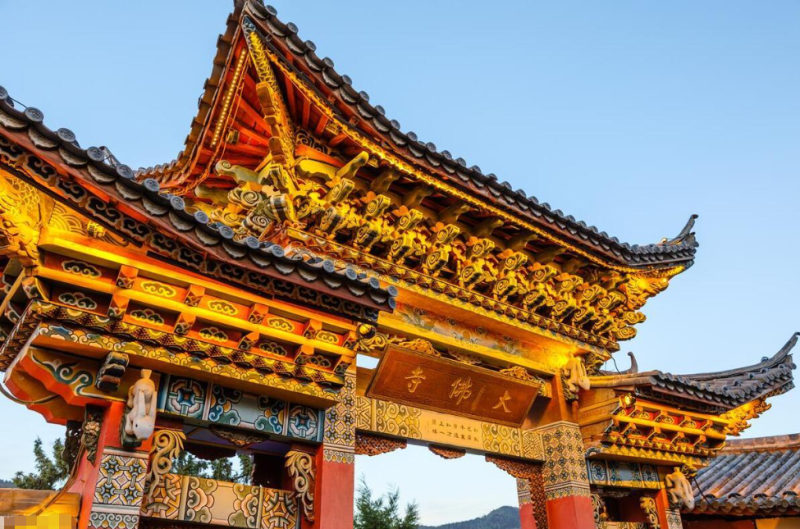
Located in the central part of Shangri-La City, Diqing Tibetan Autonomous Prefecture, Yunnan Province, Dukezong Ancient City sits in the Jiantang Town of the Zhongdian Basin. Historically, it served as a vital town and garrison for Shangri-La (also known as Gyalthang or Zhongdian) and was a key stop along the Yunnan-Tibet section of the ancient Tea Horse Road. Centered around Daguishan (Big Turtle Mountain), the city spreads out radially, covering an area of 1.5 square kilometers. The name "Dukezong" is an ancient Tibetan term, also known as "Zongrao Dangaibo" or "Daweizong," meaning "Moonlight City." It stands in contrast to "Niwangzong" by the Naizi River—the "Sunlight City" where the sun first rises. Together, they shine like the sun and moon, earning the region the poetic title of "The Sun and Moon in the Heart."
The city's layout revolves around the Sifang Street (Square Street) as its main axis, dividing the area into four districts facing east, south, west, and north, each leading to different destinations. The terrain resembles a blooming eight-petaled lotus, with three main streets (Beimen, Jinlong, and Cangfang) and 33 alleys weaving through it. With a history spanning over 1,300 years, the city's origins date back to 634 AD (the 8th year of the Zhenguan Reign of the Tang Dynasty), when Songtsen Gampo sent troops to occupy the Jiantang Basin and built an official stronghold on Daguishan. Between 676 and 679 AD, the Tubo Kingdom established a fortress on the mountain's peak, naming it "Dukezong." During the Ming Dynasty, the Mu chieftains of Lijiang occupied the southern Kham Tibetan region and relocated many Naxi people to Diqing, turning Dukezong into a Naxi military stronghold. In 1756 (the 21st year of the Qianlong Reign of the Qing Dynasty), the Zhongdian Department was established, after which "Dukezong" ceased to be used as the name for the county-level administrative body.
In 2001, Dukezong Ancient City was approved as a "Yunnan Provincial Historical and Cultural City" and was also titled a "Yunnan Provincial Famous Tourism Town." In 2005, it received the honor of "National Best Town for Ethnic Customs and Charm." In 2023, it was designated as a National 4A-level Tourist Attraction, and in May 2024, it was included in the "First Batch of Provincial Cultural Heritage Protection Lists for Place Names in Yunnan Province."