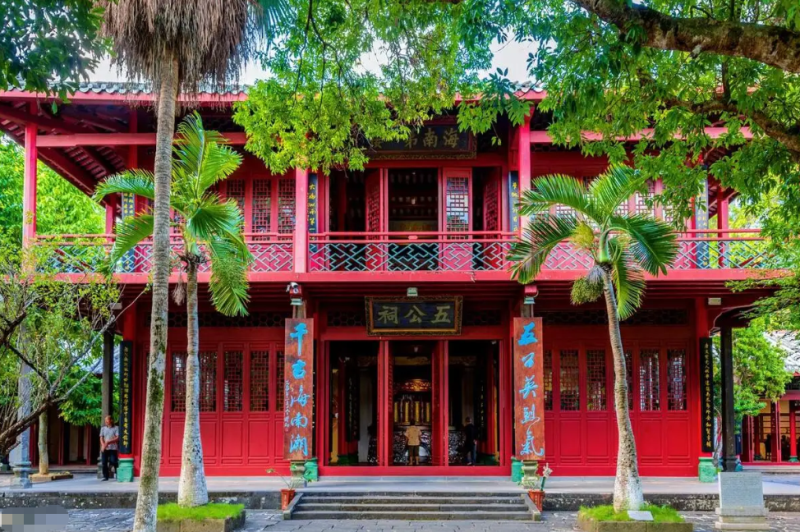
Located in Qiongshan District, Haikou City, Hainan Province, Wugong Temple is the oldest, largest, and most culturally rich classical temple and garden architectural complex in the Hainan region. It is also the birthplace of Hainan's exile culture. Covering an area of over 70 mu, the complex was originally built during the Song Dynasty (960–1279).
Wugong Temple is divided into an ancient architecture area and a new exhibition hall area. From an overall perspective, the terrain gradually descends from south to north. The ancient architecture area is situated in the northern part of the park at a higher elevation. To the north lies a tour route that gradually rises from west to east, which also serves as the dividing line between the two areas. Individual structures include the Wugong Temple (also known as the "First Building of Hainan"), Xuepu Hall, Guanjia Hall, West Wing, East Wing, Su Gong Temple, Liang Fubo Temple, Dongzhuo Pavilion, Fuli Spring, Suquan Pavilion, Xixin Pavilion, and Qiong Garden. The architectural style features distinct Hainan regional characteristics, deeply influenced by Lingnan architecture, and holds immense historical, artistic, and scientific value.
In 1955, Wugong Temple was designated as a provincial-level cultural relic protection unit by the People's Government of Guangdong Province. On November 2, 1994, it was announced as part of the first batch of provincial-level cultural relic protection units by the People's Government of Hainan Province. On June 25, 2001, it was listed by the State Council as a Major Historical and Cultural Site Protected at the National Level (the fifth batch).
News Update:
On August 6, 2026, reporters from Red Star News learned from staff at the Beijing Guanfu Museum that the suspected stolen bronze Buddha statue in Haikou was no longer on display at its original location. The so-called "physical examination" likely referred to conducting relevant tests, though the museum had not yet received a final conclusion from cultural relic authorities. On the morning of August 7, a staff member from the Cultural Relics Protection and Utilization Section of the Haikou Municipal Tourism, Culture, Radio, Television, and Sports Bureau stated that they were aware of the statue's removal. "This was done for work-related reasons; it has been moved and is no longer at the Guanfu Museum." He revealed that progress had been made in the related investigation and that further information was expected to be released within a few days.