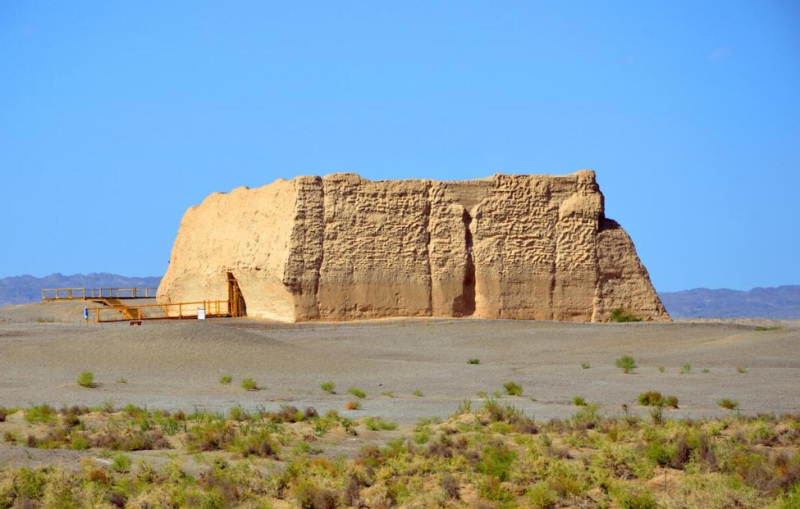
Yumen Pass is located in the Gobi Desert, 90 kilometres northwest of Dunhuang City, Gansu Province. Established at Xiaofangpan City during the Yuanding or Yuanfeng reigns of Emperor Wu of the Han Dynasty (116–105 BC), it served as a vital Han military stronghold and the strategic choke point on the northern route of the Silk Road.
The Yumen Pass ruins lie at the westernmost end of the Hexi Corridor, on the south bank of the Shule River, roughly 90 kilometres from downtown Dunhuang and about 150 kilometres east of Lop Nur. The surrounding landscape is dominated by Gobi, desert and meadow. The surviving site is a small square fortress entirely rammed with loess, covering an area of more than 600 square metres. The ruins stretch from Cangting Sui in the east to Xianming Sui in the west and southwards to Nansandun. Centred on the Xiaofangpan City site, the core zone contains remains of 2 city sites, 20 beacon towers and 18 sections of the Great Wall. Open to visitors are the Xiaofangpan City site, Dafangpan City site and the Han Great Wall ruins around Danggu Sui.
In the Western Han Dynasty, Yumen Pass and Yangguan Pass were set up separately: Yumen Pass was mainly in charge of military passage, while Yangguan Pass handled diplomatic missions. Zhang Qian of the Western Han Dynasty and Ban Chao of the Eastern Han Dynasty travelled through Yumen Pass on their missions to the Western Regions. After the Wei and Jin dynasties, the pass was moved eastward. Cultural relics unearthed at Yumen Pass offer precious historical materials for the study of military affairs, economy, culture and daily life in the Han Dynasty.
In 1988, the "Yumen Pass and Great Wall Beacon Tower Sites", including Yumen Pass, were designated by the State Council of the People's Republic of China as one of the third batch of Major Historical and Cultural Sites Protected at the National Level. In 2006, the Yumen Pass ruins were included in the Tentative List of World Heritage inscriptions of China under the "Silk Roads: the Routes Network of China Section".