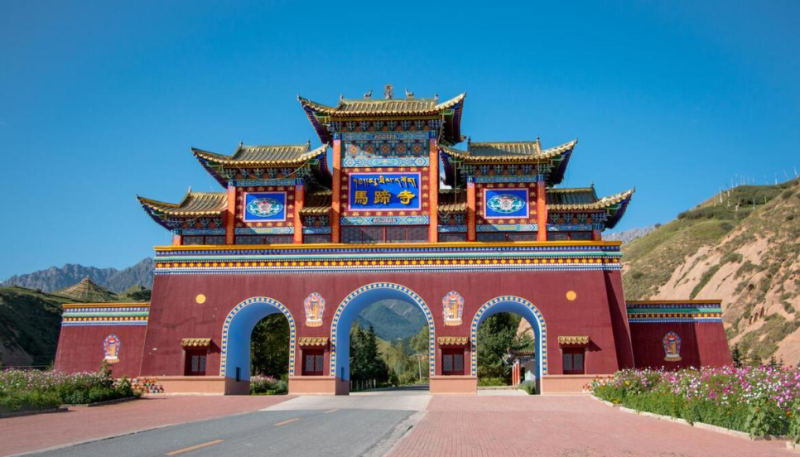
Mati Temple is located in Mati Tibetan Township, Sunan Yugur Autonomous County, Gansu Province. A national AAAA-level tourist attraction, it lies 65 kilometres from downtown Zhangye. It is an integrated tourist destination combining grotto art, the scenery of the Qilian Mountains and Tibetan ethnic customs. The scenic complex consists of seven grotto groups: the Thousand-Buddha Cave, Southern Mati Temple, Northern Mati Temple, Upper Guanyin Cave, Middle Guanyin Cave, Lower Guanyin Cave and Jinta Temple, with more than 70 surviving niches.
First built during the Northern Liang regime of the Sixteen Kingdoms period, it gets its name from the legendary hoof print of a heavenly steed preserved in the Mati Hall of Puguang Temple. Together with the Mogao Grottoes in Dunhuang and the Yulin Grottoes in Guazhou, it is hailed as one of the three great Buddhist art treasures along the Hexi Corridor. The grottoes house over 500 statues and more than 1,200 square metres of murals dating from the Northern Liang to the Ming and Qing dynasties. Among them, the Thirty-Three Heavens Grotto at Northern Mati Temple is famous for its pagoda-shaped structure of seven tiers holding 21 niches.
Carved into the cliffs in the Northern Liang era, the grotto complex has a history of over 1,600 years. In the Ming Dynasty, it was renamed Puguang Temple and granted an imperial charter by the royal court. The hoof imprint in the Mati Hall of Puguang Temple is revered as the temple’s most sacred treasure. The site suffered severe damage during the Cultural Revolution, and most of the existing buildings were restored after the reform and opening-up. It was designated a Major Historical and Cultural Site Protected at the National Level in 1996.
In recent years, efforts have been made continuously to upgrade it to a national 5A-level tourist attraction. New facilities including a welcome gate and an antique commercial block have been constructed, and a smart tourism project has been launched. In July 2025, controversy arose after scenic guides promoted an in-depth tour package on a public road and charged 300 yuan per person. The local cultural and tourism authorities responded that the fee applied to the special in-depth tour of Jinta Temple and was not a road toll, though this promotional practice by guides was immediately suspended.