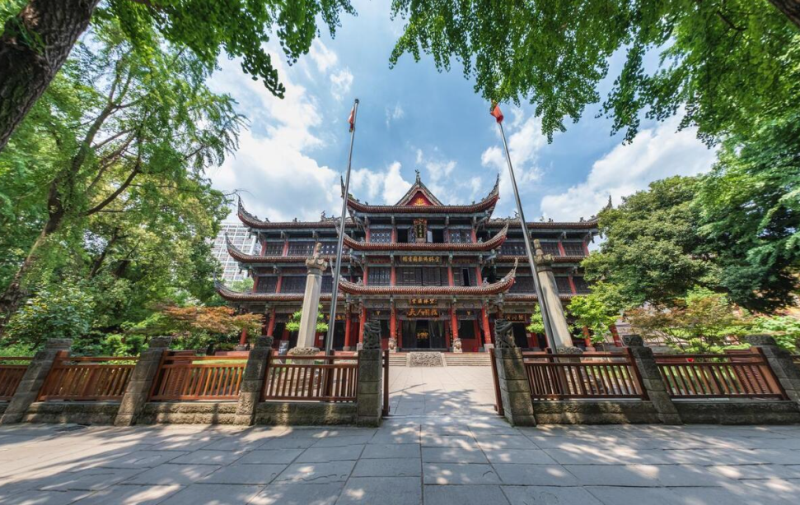
Wenshu Monastery, also known as "Konglin Hall," is located at No. 66 Wenshu Monastery Street, Qingyang District, Chengdu City, Sichuan Province, covering an area of more than 200,000 square meters. Wenshu Monastery was first built during the Daye period of the Sui Dynasty (605–617 AD). In the 36th year of the Kangxi reign (1697), funds were raised to rebuild the temple, and it was renamed Wenshu Monastery.
Wenshu Monastery is the most completely preserved Buddhist temple in Chengdu. It faces south and features architecture in the typical ancient building style of the Western Sichuan Plain, primarily consisting of wooden structures. There are six main halls; walking inward from the mountain gate, one passes in sequence through the Hall of Heavenly Kings, the Hall of the Three Great Beings, the Mahavira Hall, the Dharma Teaching Hall, and the Scripture Library. Together with the bell tower, vegetarian dining hall, corridors, and other buildings on the east and west sides, they form an integrated whole, representing typical Qing Dynasty architecture. The architecture of Wenshu Monastery is dominated by a central axis, with building styles mainly including double-eaved hip-and-gable roofs and single-eaved overhanging gable roofs, all arranged in an inward-facing layout. The layout of the buildings follows strict hierarchical and grade distinctions, reflecting the constraints of ritual propriety. Wenshu Monastery is a Buddhist sacred site integrating Chan Buddhist relics, classical gardens and ancient architecture, pilgrimage and sightseeing, and religious study.
In 1974, Wenshu Monastery was designated a "Key Cultural Relic Protection Unit" by the Sichuan Provincial People's Government. In 1983, Wenshu Monastery was designated by the State Council of the People's Republic of China as a National Key Buddhist Temple in the Han Chinese Region.