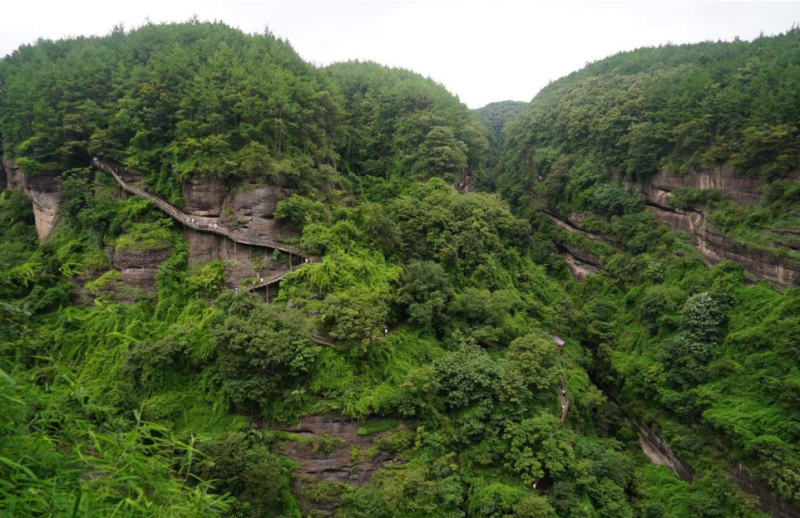
Jianmen Pass is located in the middle section of Dajian Mountain, a branch of the Longmen Mountains, in Jiange County, Guangyuan City, Sichuan Province. It is a canyon pass between Yingpanzui Peak to the east and Jincheng Mountain to the west, and a strategic point on the ancient Jinniu Road (Stone Ox Road) of the Shu Road. Because the two cliffs face each other, with peaks like swords and a formation like a gate, it is called "Jianmen" (Sword Gate).
During the Shu Han period, Chancellor Zhuge Liang, on his campaigns against Wei, established Jianmen Pass here and stationed officials to guard it. In the Tang Dynasty, Jianmen Pass was established as an administrative and military institution under Jianzhou. In the Song Dynasty, Jianmen Pass was still established and at one time was directly under the central government, governing Jianmen County. In the Yuan Dynasty, the pass was abolished and a post station was established. In the Ming Dynasty, the pass was reestablished. In the Qing Dynasty, the pass was abolished and a post station was established, and post stations were still maintained until before the 15th year of the Republic of China (1926).
Near the pass are historical sites such as the Jiang Wei City ruins, Jiang Pingxiang Shrine, Jiang Wei Tomb, Jianxi Bridge, and Zhigong Temple. On the mountain tops to the left and right of the pass are famous sites such as Liangshan Ancient Temple, Yunü Terrace, Jinghuang Cave, as well as Cuiping Peak, Sheshen Cliff, Xiannü Bridge, and Xianfeng Temple. At the pass is a stone tablet inscribed "Jianmen Pass." On the western cliff in the canyon are cliff inscriptions such as "The Greatest Pass Under Heaven" and "The First Pass," while the eastern cliff bears many poems, prose writings, and inscriptions by literati of successive dynasties.
Jianmen Pass, with its precipitous terrain, is an artery for economic and cultural communication between the Central Plains and the Southwest, and was also a strategic location contested by military strategists. It enjoys such reputations as "Jianmen, the Most Dangerous Under Heaven," "The First Pass Under Heaven," and "The Gateway to Shu." Since Qin opened the Jinniu Road, Central Plains regimes invading Shu generally entered through Jianmen Pass. In 1934, the Fourth Front Army of the Red Army and in 1949 the People's Liberation Army both captured Jianmen Pass twice.
In 1982, the "Jianmen Shu Road Scenic and Historic Area" was designated by the State Council as one of the first batch of national-level scenic and historic areas, and Jianmen Pass is the core attraction of the Jianmen Shu Road Scenic and Historic Area. In 1992, "Jianmen Pass National Forest Park" was established. In July 2015, the "Guangyuan City Jianmen Shu Road Jianmen Pass Tourist Area" was listed as a National AAAAA-level tourist attraction. In addition, the "Jianmen Shu Road Site" is a cultural relic under the sixth batch of Major Historical and Cultural Sites Protected at the National Level, and the "Shu Road" (including the Jinniu Road) was included in the "China World Cultural Heritage Tentative List" in 2012.