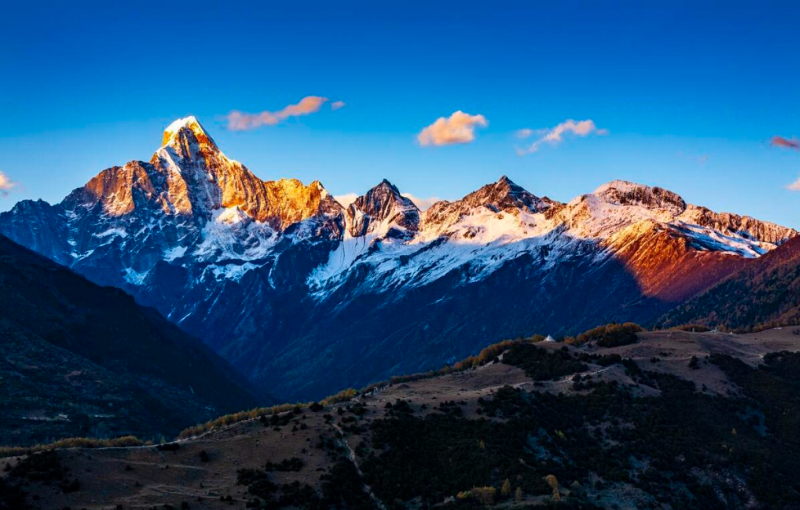
Mount Siguniang is the highest peak of the Qionglai Mountains on the eastern edge of the Hengduan Mountains. Its Tibetan name is Shigu La Rouda, meaning "Great Sacred Mountain." It consists of four peaks with elevations of 5,025 meters, 5,276 meters, 5,355 meters, and 6,250 meters, respectively. The main peak is Yaomei Peak, with an elevation of 6,247.8 meters. The four peaks are arranged in a straight line from north to south and are covered in snow and ice year-round, resembling four young women with white veils over their heads and graceful, pretty appearances—hence the name of the mountain. It is known as the "Queen of Sichuan's Mountains." Mount Siguniang is located among Wenchuan County, Xiaojin County, and Li County in Aba Tibetan and Qiang Autonomous Prefecture, Sichuan Province. It lies in the transitional zone from the Sichuan Basin to the Qinghai-Tibet Plateau and belongs to the tectonic erosional high-mountain area of the Minshan-Qionglai Mountains.
Mount Siguniang was formed when the Qinghai-Tibet Plateau was uplifted two million years ago: the granite basement of Yaomei Peak in the Longmenshan fault zone underwent weathering and denudation, and the surrounding limestone and slate, which have many fissures and are easily broken, contributed to the final formation. The area has a subtropical climate. Due to the great disparity in terrain within the area, mountain climate changes are obvious with changes in altitude. The rivers and streams in the mountains are distributed in a dendritic pattern and belong to the Qingyi River system of the Dadu River basin, a secondary tributary of the upper Yangtze River. Mount Siguniang has developed modern glaciers, ancient glacial erosion and accumulation landforms, and fluvial erosion and accumulation landforms. More than 20 peaks are covered by modern glaciers. Mount Siguniang is composed of sandstone, slate, phyllite, marble, and limestone, with exposed granite; the rocks are dense in nature, and under intense glacial and frost weathering, the peaks are sharp and steep.
Within the Mount Siguniang area are the Wolong Nature Reserve and the Mount Siguniang Scenic Area. In 1981, the main peak, Yaomei Peak, was rated as one of China's first ten famous mountains open to foreign climbers. In 1994, it was listed as a national key scenic area and included in the national nature reserve list. In 2001, it was rated as a national AAAA scenic area. In 2005, it was approved as a national geopark. In 2014, it received the title of National Environmental Science Popularization Base. In February 2024, it was rated as a national 5A-level tourist attraction.