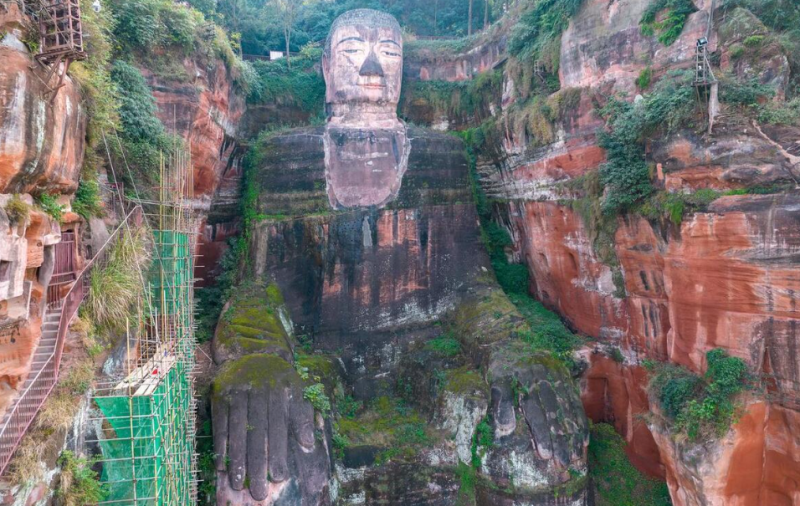
The Leshan Giant Buddha, also known as the Lingyun Giant Buddha, is formally named "the Maitreya Stone Statue of Lingyun Temple in Jiazhou." It is located beside Lingyun Temple on the east bank of the Minjiang River in the south of Leshan City, Sichuan Province. As a Major Historical and Cultural Site Protected at the National Level, the Buddha is a seated Maitreya statue with a total height of 71 meters.
Historical Evolution:The Leshan Giant Buddha was initiated for carving by the monk Haitong in the first year of the Kaiyuan era of the Tang Dynasty (713 AD). It was carved into the cliff face of Qixia Peak of Lingyun Mountain, where the Minjiang, Qingyi, and Dadu rivers converge. After three generations of craftsmen continued the construction, it was completed in the 19th year of the Zhenyuan era. It has been repaired and maintained in many subsequent dynasties.
Overview of the Statue:The Buddha has 1,051 hair coils on its head, a forehead 10 meters wide, a nose 5.6 meters long, a neck 3 meters high, shoulders 28 meters wide, fingers 8.3 meters long, and insteps 8.5 meters wide. On the cliff walls along the river on both sides of the Buddha, there are also two guardian Heavenly King statues, each over 16 meters tall. On the right side of the Buddha is a nine-bend ancient plank road carved along the precipice. The rock body of the Buddha is red-bed sandstone with poor resistance to weathering. Under the long-term effects of wind and sun as well as alternating dry and wet climates, it has gradually become rough and fragile.
Value and Significance:The Leshan Giant Buddha is the largest extant cliff-carved stone statue in the world, possessing extremely high historical, artistic, and scientific value. Situated on an important route of the Southern Silk Road, it reflects the developed economy and convenient transportation status of Jiazhou in the Tang Dynasty; the drainage system hidden within the Buddha's body demonstrates the engineering wisdom of the ancients, and the traditional techniques it employed, such as hammered ash, have continued to be used. In 1996, it was inscribed on the UNESCO World Cultural and Natural Heritage List.