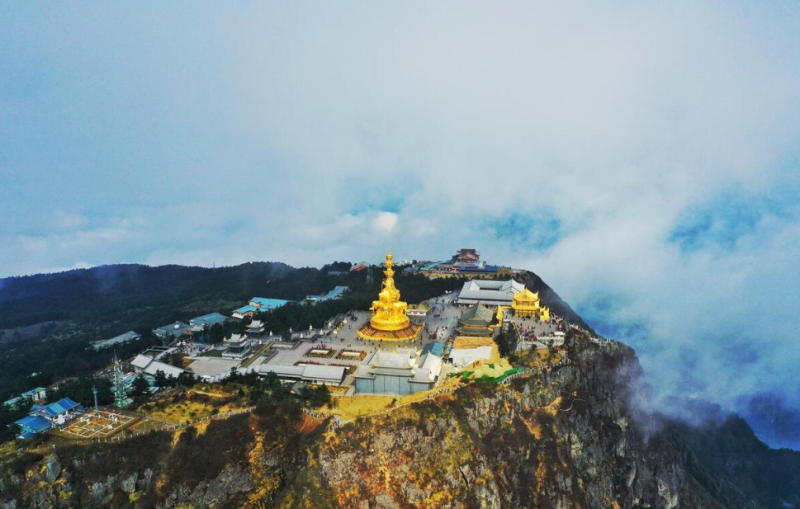
Mount Emei, also written as "Mount Emei," is a branch range of the Qionglai Mountains, located at the southwestern edge of the Sichuan Basin in China, between 29°16′–29°43′ N latitude and 103°10′–103°37′ E longitude. It rises abruptly from the Emei Plain, with its body extending north-south for 105 kilometers. Its main peaks are Da'e Mountain, Er'e Mountain, San'e Mountain, and Si'e Mountain, among which Da'e Mountain is the Mount Emei Scenic Area, covering an area of 154 square kilometers, with its main peak, Golden Summit, and its highest peak, Wanfo Summit, at an elevation of 3,099 meters.
Due to the Himalayan movement, the main body of Mount Emei was strongly uplifted along faults, forming the present-day Mount Emei. The geological foundation of the main body of Mount Emei is a north-south short anticline. In terms of the agents shaping the landforms, it can be divided into erosional landforms (the Mount Emei area) and depositional landforms (the Mount Emei fan-shaped alluvial-proluvial plain); by origin, it can be divided into tectonic landforms, fluvial landforms, karst landforms, and glacial landforms. In the low mountain and hilly area from the Emei Plain down to Wannian Temple, the soils are mainly purple soil and yellow soil. Affected by the monsoon circulation, areas of Mount Emei above 2,000 meters are covered by ice and snow for about half the year, with no distinction of four seasons, only that of winter and spring.
Mount Emei has a profound cultural heritage. Buddhist, Daoist, martial arts, and mountain tea cultures flourished at Mount Emei, and many historical figures left poems here; in 1996, most of the cultural relics of Mount Emei were inscribed by UNESCO on the World Cultural Heritage List.
In 2024, Mount Emei was selected into the first list of 14 World Tourism Famous Mountains.