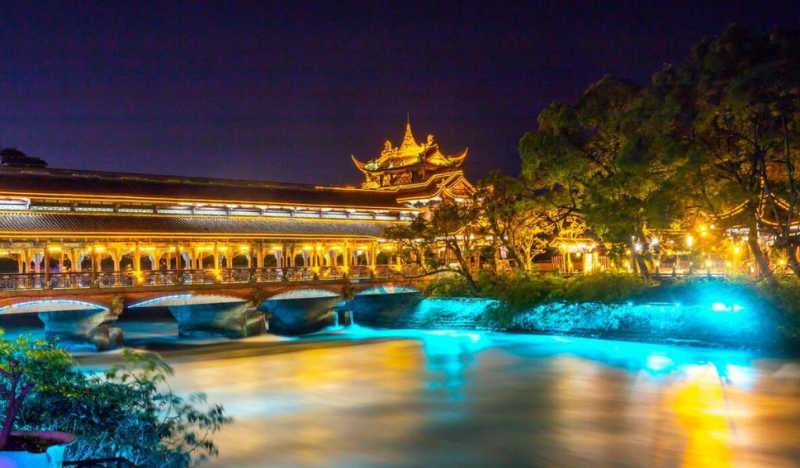
Dujiangyan is located in the west of Dujiangyan City, Chengdu, Sichuan Province, situated on the Minjiang River in the western part of the Chengdu Plain. It is a massive engineering system consisting of the canal head hub (Yuzui, Feishayan, and Baopingkou), water diversion channels at all levels in the irrigation area, various engineering structures, and large, medium, and small reservoirs and ponds. The canal head covers an area of over 200 mu. It is responsible for irrigating more than 11.65 million mu of farmland in 41 counties (cities and districts) across 8 cities (prefectures) in the central and western parts of the Sichuan Basin, supplying water to multiple key enterprises and for urban domestic use in Chengdu, and providing comprehensive services for multiple objectives including flood control, power generation, log drifting, aquatic products, aquaculture, fruit forestry, tourism, and environmental protection. It is an irreplaceable water conservancy infrastructure for the national economic development of Sichuan Province.
In the late period of King Zhao of Qin (approximately 276 BC to 251 BC), Li Bing, the governor of Shu Commandery, summarized the water management experience of his predecessors and organized the people on both banks of the Minjiang River to build Dujiangyan. During the Tang Dynasty, Feishayan was constructed. After the founding of the People's Republic of China, industrial water supply channels, the outer river sluice, and the temporary water-retaining sluice for industrial water diversion at Feishayan were also built. To effectively manage and maintain the operation of Dujiangyan, officials for the weir and an annual maintenance system were established.
Dujiangyan is the oldest surviving grand water conservancy project in the world today and the only one characterized by diversion without a dam. It makes full use of the local geographical conditions of being higher in the northwest and lower in the southeast, and based on the special terrain, water veins, and water flow conditions at the mountain outlet of the river, it guides the water according to the situation, diverts water without a dam, and provides gravity irrigation, so that embankments, water distribution, flood discharge, sediment flushing, and flow control are interdependent and form a unified system, ensuring the full realization of the comprehensive benefits of flood control, irrigation, water transport, and social water use. Its greatest aspect is that it has remained prosperous for more than 2,250 years since its construction and is playing an increasingly greater role.
Dujiangyan is a World Cultural Heritage site, an important component of World Natural Heritage, a World Heritage Irrigation Structure, a Major Historical and Cultural Site Protected at the National Level, a National-Level Scenic and Historic Area, and a National AAAAA-Level Tourist Attraction.
From March 18 to April 30, 2025, Gate 6 (Qinyan Tower) of Dujiangyan Scenic Area will undergo closed renovation and upgrading.