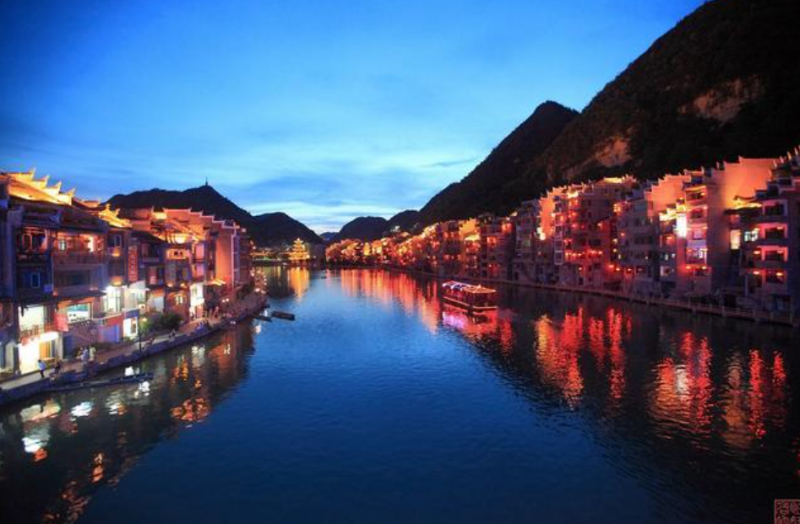
Zhenyuan County is a county under the jurisdiction of Qiandongnan Miao and Dong Autonomous Prefecture, Guizhou Province. It is located in the Wuling Mountain area in eastern Guizhou, a sloping transitional zone from the Guizhou Plateau to the Xiangxi Hills. It borders Xinhuang County of Hunan Province to the east, Sansui and Jianhe to the south, Shibing to the west, and Cengong and Shiqian County of Tongren City to the north. It is the eastern gateway of Guizhou Province and belongs to the mid-subtropical humid climate zone, with a total area of 1,889.84 square kilometers. As of March 2026, Zhenyuan County governs 8 towns and 4 townships. As of the end of 2025, the permanent resident population of Zhenyuan County was 188,300.
Zhenyuan has a long history. It has been more than 2,200 years since the county was established in the fifth year of Emperor Gaozu of Han (202 BC). In 1986, it was designated a China Historical and Cultural City. In 2020, Zhenyuan Ancient City was designated a national 5A-level tourist attraction. It is rich in tourism resources and enjoys such honors as "China's Most Influential Tourist County," "China's Top Ten Tourist Ancient Cities," and "China's Ten Most Beautiful Ancient Cities." On April 24, 2019, Zhenyuan County was removed from the list of poverty-stricken counties. In 2019, it was selected as one of China's Top 100 Tourist Counties. It is one of the birthplaces of modern heavy industry in China. The Qingxi Ironworks was a product of the modern "Self-Strengthening Movement," and the "Tianzi No. 1" steel ingot is still preserved in the Zhenyuan Museum. Transportation is convenient. Within the county there are the Xiang-Qian Railway, the Zhuliu Double-Track Railway, the Shanghai-Kunming Expressway, the Yanrong Expressway, the Tianhuang Expressway, and national highways such as G211, G320, and G551.
In 2025, the gross domestic product of Zhenyuan County was 7.857 billion yuan, an increase of 5.1% compared with the same period of the previous year.