Erhai Lake is located in Dali City, Dali Bai Autonomous Prefecture, Yunnan Province. It is the second-largest freshwater lake in Yunnan Province, belonging to the Lancang River basin, with a lake surface elevation of 1,972 meters. The core scenic area covers about 256.5 square kilometers, stretching 42 kilometers from north to south and 6–7 kilometers on average from east to west, with a maximum depth of 21.3 meters. Erhai Lake is a national-level scenic area and a national 4A tourist attraction, known as the "Pearl of the Plateau." It combines mountain and water scenery, Bai culture, and ecological wetlands. The lake water is clear as a mirror, and together with the snow on Cangshan Mountain and Bai villages, it forms the classic "wind, flowers, snow, and moon" landscape. Along its shores are famous attractions such as the Three Pagodas of Chongsheng Temple, Shuanglang Ancient Town, and Xizhou Ancient Town, making it the core destination for tourism in Dali.
History and Culture
The Erhai Lake region is one of the important birthplaces of ancient civilization in Yunnan. As early as the Neolithic Age, humans lived and multiplied here. In the Han Dynasty, it was called "Yeyu Ze." During the Nanzhao Kingdom of the Tang Dynasty, it became an important area of royal activity, and historical records describe it as "two hundred li in circumference, several zhang deep, rich in fish and water chestnuts." During the Dali Kingdom of the Song Dynasty, landmark structures such as the Three Pagodas of Chongsheng Temple and the Taihe City ruins were built around Erhai Lake, making it the political and cultural center of western Yunnan.
Erhai Lake carries a rich Bai culture. Villages along the shore preserve traditional dwellings such as the "three rooms and one screen wall" and "four courtyards with five skywells." Bai intangible cultural heritage such as tie-dyeing, embroidery, and the Three-Course Tea is passed down here. Fishermen continue the thousand-year-old "cormorant fishing" technique (now a provincial-level intangible cultural heritage), and the Raosanling folk activity demonstrates the ecological wisdom of harmonious coexistence between humans and nature. In addition, Tang Dynasty poet Liu Changqing and Ming Dynasty traveler Xu Xiake both left poems and writings at Erhai Lake, adding cultural depth to the scenic area.
Main Attractions
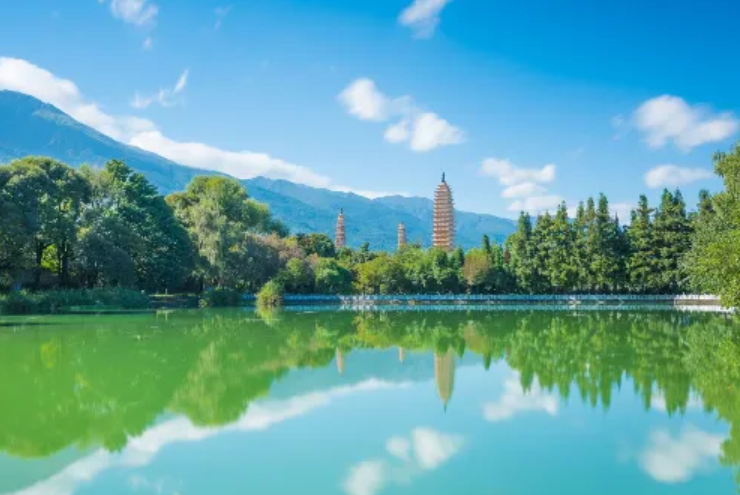
Three Pagodas of Chongsheng Temple
A nationally protected key cultural heritage site, located about 1.5 kilometers north of Dali Ancient Town. The main pagoda is 69.13 meters high and is a Tang Dynasty密檐式 square hollow brick pagoda. The two side pagodas are 42.19 meters high and octagonal. They were first built during the Nanzhao Kingdom period (8th century AD) and are a symbol of Dali. Having survived earthquakes for a thousand years, the Three Pagodas remain well preserved. More than 600 cultural relics were unearthed from the pagodas and are now kept in the scenic area museum.
Shuanglang Ancient Town
Located on the northeast shore of Erhai Lake, it is a traditional Bai fishing village known as "the number one town for Cangshan and Erhai scenery." The ancient town covers about 2.5 square kilometers. It is marked by Yang Liping's Sun Palace and Moon Palace architectural complex, which blends Bai dwellings with modern artistic style. Visitors can take a boat to Nanzhao Customs Island (0.18 square kilometers, with a 14-meter-high Acuoye Guanyin statue), or cycle along the East Ring Sea Road to enjoy the "Cangshan and Erhai in a single line of sky" landscape.

Xizhou Ancient Town
Located on the northwest shore of Erhai Lake, it is an important town of Bai commercial culture. During the Ming and Qing dynasties, the "Xizhou Merchant Group" was famous in western Yunnan. The ancient town preserves a group of Ming and Qing residential buildings covering about 1.5 square kilometers. It is represented by the Yan Family Courtyard (with a building area of 2,478 square meters and a three-entry, four-courtyard, five-skywell layout) and the Corner Tower. Bai tie-dye workshops and rice field scenery (the core rice field area is about 500 mu) are its main features.
Erhai Ecological Corridor
An ecological protection project around the west shore of Erhai Lake, with a total length of 46 kilometers, of which the demonstration section (from Dali Ancient Town to Caicun) is 8 kilometers long. The corridor integrates wetland restoration, cultural display, and leisure sightseeing. It has more than 30 kinds of aquatic plants and features viewing platforms and bicycle lanes. Visitors can observe the water quality of Erhai Lake up close (currently maintained at Class II standard) and the wintering red-billed gulls (about 100,000 gulls inhabit the area from November to March each year).
Tour Routes:
One-day tour:
Route 1 (Cultural experience): Dali Ancient Town → Three Pagodas of Chongsheng Temple (2 hours) → Xizhou Ancient Town (visit Yan Family Courtyard, take photos in the rice fields, 2 hours) → Zhoucheng (visit tie-dye workshop, 1 hour) → return to the ancient town.
Route 2 (Around-the-lake scenery): Caicun Pier → cycle along the Erhai Ecological Corridor (rent an electric bike, 30 yuan/day, from Dali Ancient Town to Panxi section, about 15 kilometers, 3 hours) → Shuanglang Ancient Town (lunch, visit Sun Palace, 3 hours) → Wase Town (take photos at Little Putuo Island, 1 hour) → return.
Two-day tour:
Day 1: Dali Ancient Town → Three Pagodas of Chongsheng Temple → Xizhou Ancient Town (stay overnight in Xizhou, experience a Bai guesthouse);
Day 2: Shuanglang Ancient Town → Nanzhao Customs Island → Wase Town → Wenbi Village (watch the sunset) → return to the ancient town.
Travel Tips:
Best season: Spring and autumn (March–May, September–November), with temperatures of 15–22°C. This avoids the summer crowds and the rainy season (June–August has frequent showers).
Clothing: There is a large temperature difference between day and night, so bring a light jacket. The ultraviolet rays are strong, so wear a hat and sunglasses and apply SPF50 sunscreen.
Accommodation choices:
Dali Ancient Town: convenient for nightlife, recommended near the South Gate;
Shuanglang/Wase: mainly sea-view rooms, suitable for watching the sunrise;
Xizhou: experience pastoral scenery.
Avoid pitfalls: Refuse low-priced "one-day around-the-lake tours" solicited by roadside touts, as they may force shopping. Check the battery and brakes before renting an electric bike.
Notes:
Ecological protection: Swimming, fishing, and releasing invasive species in Erhai Lake are prohibited. Violators may be fined up to 2,000 yuan (Regulations on the Protection and Management of Erhai Lake).
Respect local customs: Bai people avoid spitting into the fire pit and touching children's heads. Remove hats when entering religious sites, and ask for permission before taking photos.
Safety tips: Some sections of the West Ring Sea Road are close to the lake without guardrails, so pay attention to safety when cycling. Mountain weather changes quickly, so bring rain gear.
Altitude sickness: At an altitude of about 2,000 meters, a few people may experience mild headaches. Avoid strenuous exercise and drink plenty of water.
Transportation:
By plane: About 30 kilometers from Dali Airport. A taxi costs 40–60 yuan, or take the airport shuttle bus to Dali Ancient Town (25 yuan/person, 1 hour).
By high-speed rail: Dali Station is about 13 kilometers from the ancient town. A taxi costs 30–40 yuan, or take Bus No. 8 (2 yuan/person, 40 minutes) to the ancient town.
Around-the-lake transportation:
Self-driving rental car: An SUV costs about 200–300 yuan/day. Note that some sections of the West Ring Sea Road have width restrictions;
Electric bike/bicycle: Electric bikes cost 50–80 yuan/day (range 60–100 kilometers), bicycles 20–30 yuan/day;
Tourist shuttle: Direct bus from Dali Ancient Town to Shuanglang Ancient Town (30 yuan/person, 1.5 hours), departing daily from 8:00 to 16:00.
Opening Hours:
Erhai Lake is open all day.
Tickets:
Erhai Lake Scenic Area is free and open to the public. Attractions and activities within the scenic area require payment.