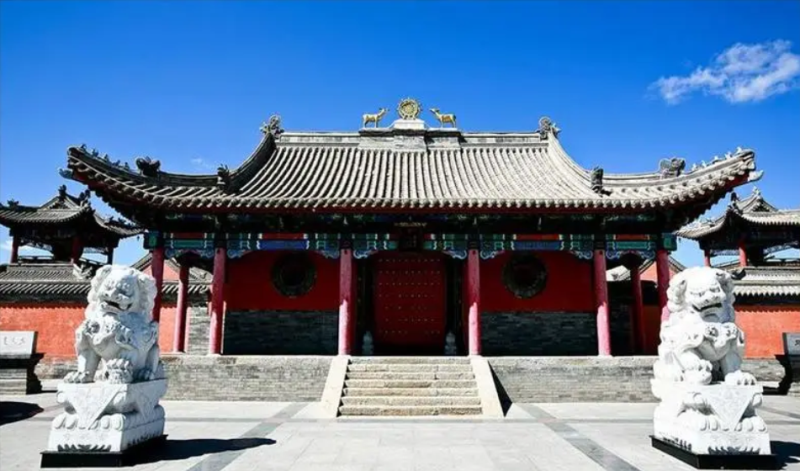
Beizi Temple, known in Mongolian as "Banzhida Gegen Temple" and in Chinese as "Chongshan Temple," is one of the four major temples in Inner Mongolia. It is located at the southern foot of the "Erdun Taoligai" Ovoo in the north of Xilinhot City, Xilin Gol League. The temple's formal name is "Jianglong Banzhida Gegen Khutagt" or "Arya Jianglong Bandida Gegen Sum," named after the title of its first living Buddha. It has also been known by various other names, such as "Gegen Sum," "Gegen Khutagt," and "Bandida Gegen Sum." Commonly referred to as "Bandida Gegen Sum" or simply "Beizi Temple," it is also affectionately known as the "Grand Temple."
Construction began in the 8th year of the Qianlong reign of the Qing Dynasty (1743). Refined and expanded by seven generations of living Buddhas, the project cost over 1.74 million taels of silver. The complex consists of five main halls: the central Chaokeqin Hall (for administration and religious affairs), flanked by the Labuleng Hall (the Living Buddha's residence), the Queri Hall (for philosophy), the Manba Hall (for medicine), and the Zhuduoduba Hall (for astronomy and mathematics). Additionally, there were over a dozen smaller halls and more than 2,000 lamas' residences surrounding the main structures, bringing the total area to 1.2 square kilometers after completion.
As a sacred site of Tibetan Buddhism, Beizi Temple has historically been regarded as the largest temple in the Xilin Gol League region. It serves as a significant treasury of Buddhist culture in the area and enjoys the reputation of being a "Famous Temple of the North." The surroundings feature lush pastures and beautiful scenery, with the holy Xilin River flowing gently from south to north along the western side of the temple—though today, its banks are lined with a bustling urban area. Legend has it that the temple site was chosen as an auspicious treasure land. During its century-long period of prosperity, the temple housed up to 1,200 lamas. The senior lamas maintained close ties with religious elites in Lhasa, Tibet, and Mount Wutai in Shanxi, often undertaking arduous pilgrimages on foot to Lhasa to worship and retrieve scriptures. However, the temple gradually declined following the fall of the Qing Dynasty.
In 2006, Beizi Temple was designated as a Major Historical and Cultural Site Protected at the National Level. It was rated as a National 4A-level Tourist Attraction in 2008. However, in September 2026, the Beizi Temple tourist area had its scenic area quality rating revoked.