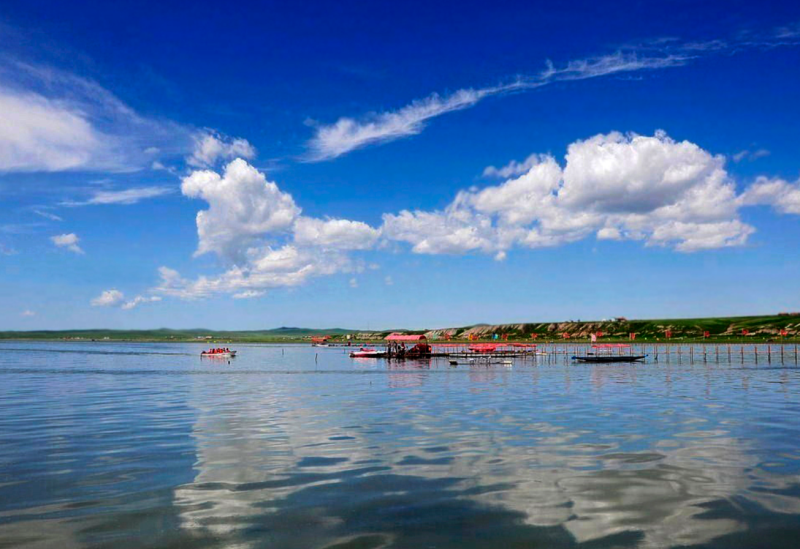
Hulun Lake, also known as Hulun Pool, Dalai Lake, or Dalai Nur (meaning "Sea-like Lake" in Mongolian), has borne many historical names, such as Daze, Julun Po, Kuolian Haizi, Hutu Ze, Xuanmo Chi, and Kulun Lake. Located within the Argun River basin, it sits at the junction of New Barag Right Banner, New Barag Left Banner, and Jalainur District in western Inner Mongolia. The lake sits at an altitude of 545.3 meters. It has an irregular elongated shape with its major axis running from southwest to northeast. Spanning 93 kilometers in length and 41 kilometers at its widest point (averaging 32 kilometers wide), it has a shoreline of 447 kilometers. With a total area of 2,315 square kilometers (some sources cite 2,339 sq km), a maximum depth of 8 meters, an average depth of 5.7 meters, and a storage capacity of 13.85 billion cubic meters, it stands as the largest lake in Inner Mongolia.
The surface water system of Hulun Lake consists of the lake itself, the Halaha River, Buir Lake, the Urxun River, the Kherlen River, the Xin Kai River, and the Dalan Ormu River, which connects Hulun Lake to the Argun River. The total drainage area (within China) covers 37,214 square kilometers. The Kherlen and Urxun rivers serve as the primary sources of replenishment, while the Xin Kai and Dalan Ormu rivers act as the main regulators.
The Hulun Lake region is a primary cradle for many nomadic peoples of the North. Historically, ethnic groups such as the Donghu, Xiongnu, Xianbei, Shiwei, Uyghur, Turk, Khitan, Jurchen, and Mongol have lived and thrived here.
Situated in the heart of the Hulunbuir Grassland, Hulun Lake is renowned as the "Pearl of the Grassland" and the "Kidney of the Grassland." It holds a unique status in regional ecological conservation and plays a vital role in maintaining the biodiversity and rich flora and fauna of the Hulunbuir Grassland. The lake and its surrounding water systems were listed in the Directory of Internationally Important Wetlands under the Ramsar Convention in January 2002, and in November 2002, it was approved to join the UNESCO World Network of Biosphere Reserves.