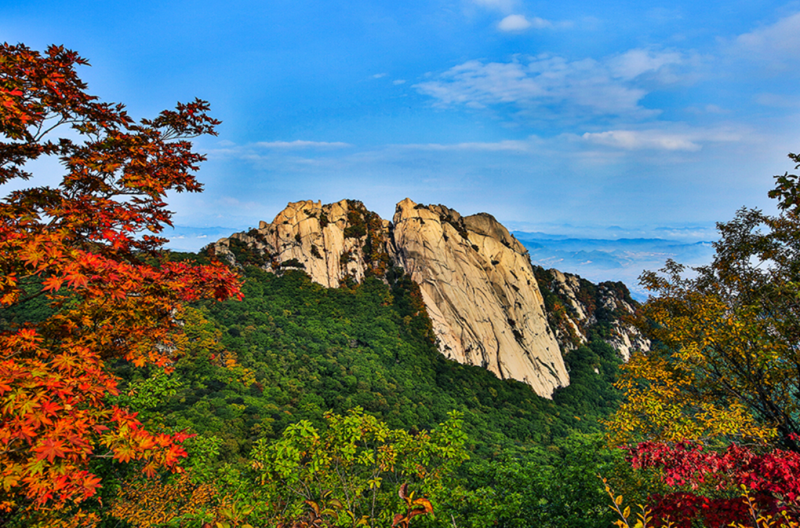
Phoenix Mountain, known in ancient times as Longshan (Dragon Mountain) and Helongshan, is located in Shuangta District, Chaoyang City, Liaoning Province. Covering an area of 67.84 square kilometers, it is a national 4A-level tourist attraction and a national forest park, with its main peak reaching an elevation of 660 meters. Its history dates back to the Former Yan period, when Murong Huang built the Longxiang Buddhist Temple here in 341 AD — the earliest Buddhist temple in Northeast China. During the reign of Emperor Wen of the Sui Dynasty, an imperial edict ordered the establishment of a shrine at Longshan in Yingzhou. Today, three pagodas from the Liao Dynasty still stand here — the Lingxiao Pagoda, the Moyun Pagoda, and the Great Pagoda — along with four temples: Yanshou Temple, Tianqing Temple, Yunjie Temple, and Huayan Temple. These temples enshrine the bodily relics of Shakyamuni Buddha and Dipankara Buddha, which were unearthed from the North Pagoda and South Pagoda of Chaoyang, respectively. During the Qing Dynasty, Emperor Qianlong renamed it Phoenix Mountain, drawing on a classical allusion from The Book of Songs (Shijing).
The scenic area has a temperate monsoon climate, with a forest coverage rate of 85%. It is home to 790 species of plants and 330 species of wild animals, including nationally protected species such as the golden eagle and the black stork. Major natural attractions include the Natural Great Buddha and "Huatuo Paying Homage to Maitreya," while cultural relics feature the Yunjie Temple Pagoda, cliff-carved Buddhist niches, and the Liao Dynasty stone inscription of the Jade Guanyin statue with accompanying poems.
The scenic area is open from 06:00 to 18:00 in summer and autumn, and from 07:00 to 17:00 in winter and spring. Admission is 80 yuan. Visitors can get there by taking Bus Route 10, 14, or 15.