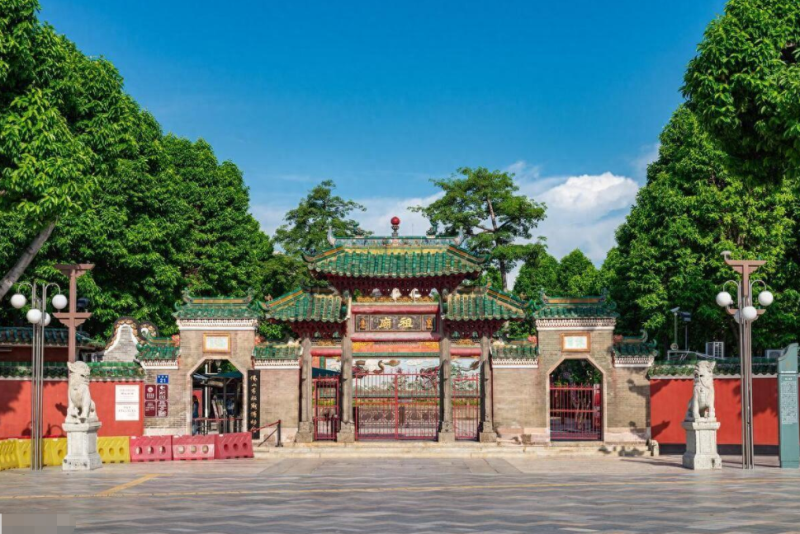
The Foshan Ancestral Temple, also known as the "Beidi Temple" or "Lingying Shrine," is located at No. 21 Zumiao Road, Chancheng District, Foshan City, Guangdong Province. Dedicated to the Taoist deity Zhenwu Xuantian Shangdi (the Northern Emperor), it was first built during the Yuanfeng era of the Northern Song Dynasty (1078–1085). It originated from the worship of the Northern Emperor brought to Lingnan by migrants from the Central Plains. The temple was renovated in the fifth year of the Hongwu era of the Ming Dynasty (1372) and gradually evolved into a complete, structurally rigorous temple complex with strong local characteristics by the early Qing Dynasty.
Covering an area of 3,500 square meters, the architectural complex consists of buildings arranged along a central north-south axis, including the Wanfu Stage, Lingying Archway, Jinxiang Pool, Bell and Drum Towers, the Three Gates, the Front Hall, the Main Hall, and the Qingzhen Building. The entire complex primarily utilizes wood and stone. The bracket sets and beam frameworks are constructed with solid timber using mortise and tenon joints. The roof ridges are adorned with Shiwan ceramic sculptures (known as "ridge figurines"), while the surrounding walls are inlaid with extensive brick and lime carvings. Inside the halls, one can find an array of artworks in wood carving, stone carving, and castings of iron, copper, and tin, making it truly a palace of art.
On November 20, 1996, the Foshan Ancestral Temple was listed by the State Council of the People's Republic of China as a Major Historical and Cultural Site Protected at the National Level (the fourth batch). In 2003, it was selected as one of the "Eight New Scenic Spots of Foshan."