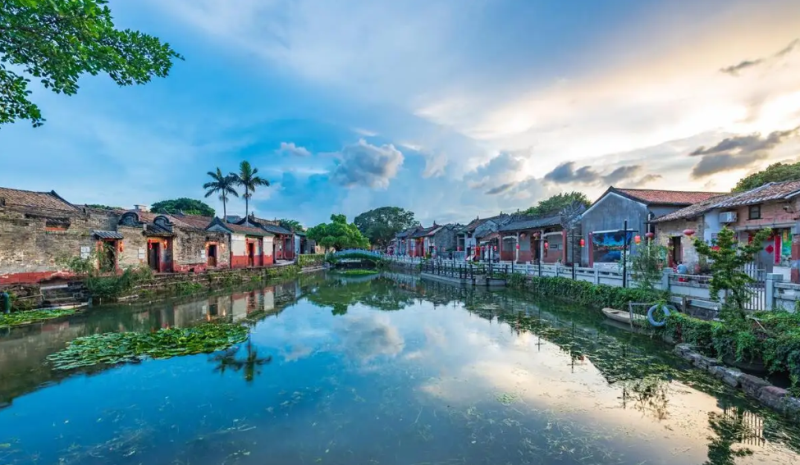
Nanshe Village, originally named "Nanshe Village", is an administrative village under the jurisdiction of Chashan Town in Dongguan City, Guangdong Province. It is recognized as a Famous Historical and Cultural Village of China and a Traditional Chinese Village. Located 18 kilometers from downtown Dongguan and 2.5 kilometers from the Chashan Town People's Government, the village covers an area of 4 square kilometers. It was named for its location by the Nansheliang River, a tributary of the Dongjiang River, and was later renamed to avoid the taboo associated with the character for "snake" (which sounded similar to the original name).
Situated in a plain area with a subtropical monsoon climate, Nanshe Village dates back to the Southern Song Dynasty. According to the Genealogy of the Xie Clan of Nanshe, when the ancestor Xie Shangren settled here in 1275 AD (the first year of the Deyou era of Emperor Gong of Song), families with surnames such as Qi, Mai, Wei, and Chen were already living there. After more than 760 years of development, Nanshe Village gradually evolved into the Nanshe Ming and Qing Ancient Village, dominated by the Xie clan. The village currently preserves 32 ancestral halls, over 250 ancient residences, 40 ancient wells, and 5 temples. The architectural complex of Nanshe is a typical representative of Ming and Qing dynasty architecture. It serves as a prime example for studying ancient Chinese agricultural settlement culture and Lingnan-style architecture from that era. As a component of the "Ancient Buildings of Nanshe Village and Tangwei Village," it was listed as a Major Historical and Cultural Site Protected at the National Level (the 6th batch), possessing significant historical, cultural, and architectural value.
On September 16, 2005, Nanshe Village was awarded the title of the second batch of "Famous Historical and Cultural Villages of China" by the Ministry of Construction and the State Administration of Cultural Heritage. Later, on December 17, 2012, it was announced as part of the first batch of "Traditional Chinese Villages" by the Ministry of Housing and Urban-Rural Development, the Ministry of Culture, and the State Administration of Cultural Heritage.