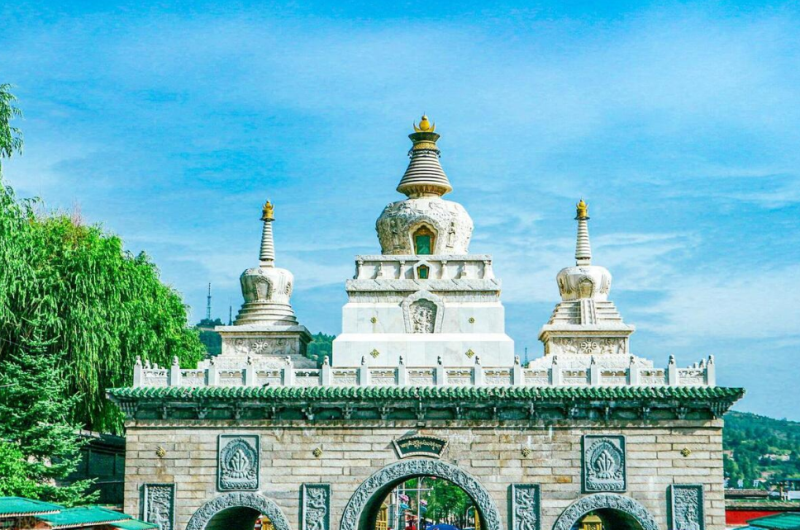
Kumbum Monastery, known in Tibetan as “Gumbum Sampa Ling”, meaning "the Land of Ten Thousand Maitreya Images", sits in the Lotus Mountain Valley of Lushar Town, Huangzhong District, Xining City, Qinghai Province, about 26 kilometres from downtown Xining. In the 12th year of the Hongwu reign of the Ming Dynasty (1379), Tsongkhapa’s mother built the Lotus Assembly Pagoda following her son’s instruction to "erect a pagoda at the place of his birth". This marked the origin of Kumbum Monastery. Its Chinese name, Ta'er Si (Pagoda Temple), derives from the fact that "the pagoda came before the temple".
It is one of the six great monasteries of the Gelug school of Tibetan Buddhism and the birthplace of Master Tsongkhapa, the founder of the Gelug school. Held in deep reverence by believers, it serves as a major site for religious activities and pilgrimage in Northwest China.
Following the undulating terrain of Lotus Mountain, the monastery complex is laid out centripetally, with the Great Golden Roof Hall as its core. It blends Tibetan flat-roofed blockhouse architecture with the multi-eaved hip-and-gable roofs of Han style. Gilded roofs, pangma walls and glazed brick carvings set off one another, making it a masterpiece combining Han and Tibetan architectural arts. Major structures include the Great Golden Roof Hall, the Grand Scripture Hall, the Nine-Room Hall, the Lesser Golden Roof Hall, the Eight Stupas of Tathagata, as well as the four colleges for Exoteric Buddhism, Esoteric Buddhism, Medicine and Kalachakra. The total floor area of the monastery is around 100,000 square metres.
The monastery is famed for its “Three Great Arts”:butter sculptures, murals and appliqué embroidery. Integrating sculpture, painting and needlework, these works feature a wide range of themes and exquisite craftsmanship. They stand as outstanding examples of Tibetan Buddhist plastic arts in China, boasting immense artistic and historical value. As the birthplace of Tsongkhapa and a hub for Gelug monastic education, Kumbum Monastery has been one of the economic and cultural centres of Tibetan Buddhism since the Ming and Qing dynasties. Its architecture and art form a vital part of the Chinese nation’s cultural treasury.
On 4 March 1961, Kumbum Monastery was designated by the State Council of the People’s Republic of China as one of the first batch of Major Historical and Cultural Sites Protected at the National Level. In 2007, it was added to the tentative list of the transnational World Heritage nomination for the Silk Roads.