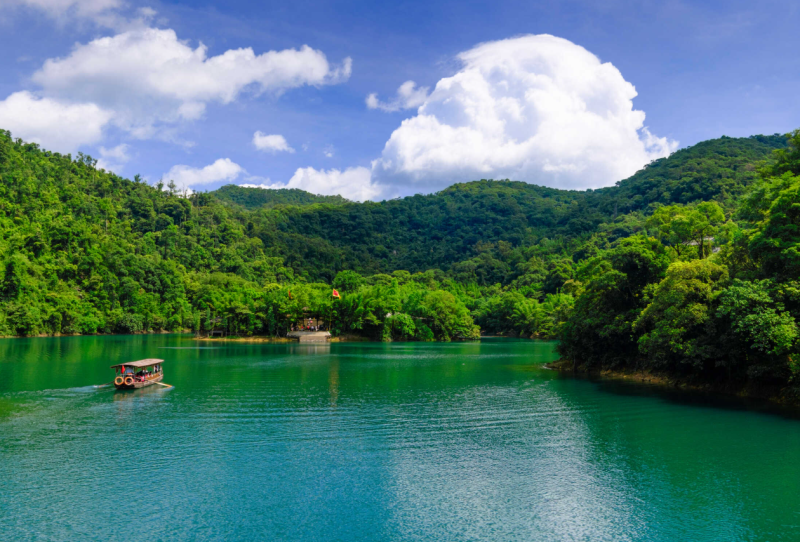
Located in the northeast of Zhaoqing City, Guangdong Province, Dinghu Mountain sits just 18 kilometers from the urban area. It comprises over ten peaks, covering a total area of 11.33 square kilometers, with its highest point, Jilong Mountain (Chicken Cage Mountain), reaching an altitude of 1,000.3 meters.
Thanks to its superior geographical location, it is hailed as the "closest primary secondary forest to a city." Together with Luofu Mountain in Huizhou, Danxia Mountain in Shaoguan, and Xiqiao Mountain in Foshan, it is recognized as one of the "Four Famous Mountains of Lingnan."
Dinghu Mountain is often regarded as the foremost of these four famous mountains, as it serves as a premier destination integrating scenic tourism, scientific research, and religious pilgrimage.
The origin of its name is subject to various interpretations. Some say it was originally called "Ding" (Top) Lake because there was a lake on the summit that never dried up throughout the seasons. Others suggest that the main peak is round and elegant, while the surrounding peaks branch out like a tripod (Ding), hence the name "Dinghu." There is also a folk legend that the Yellow Emperor bestowed a tripod here, leading to the common name Dinghu Mountain.
In 1956, it became China's first national nature reserve. In 1979, it was among the first batch of sites in China to join the UNESCO "Man and the Biosphere (MAB)" program, earning it the reputation of a "Living Natural Museum."
With extremely high levels of negative oxygen ions in the air, it enjoys the title of a "Natural Grand Oxygen Bar."
Dinghu Mountain preserves a primary secondary forest of south subtropical zonal evergreen broad-leaved forest with a history of over 400 years. It serves as an in-situ conservation site for 1,948 species of wild higher plants, 327 species of animals, and 980 species of insects. Among these, there are 32 species of wild animals and 23 species of wild plants under special state protection. As a genetic reservoir for biodiversity in South China, it is celebrated as the "Emerald on the Tropic of Cancer."